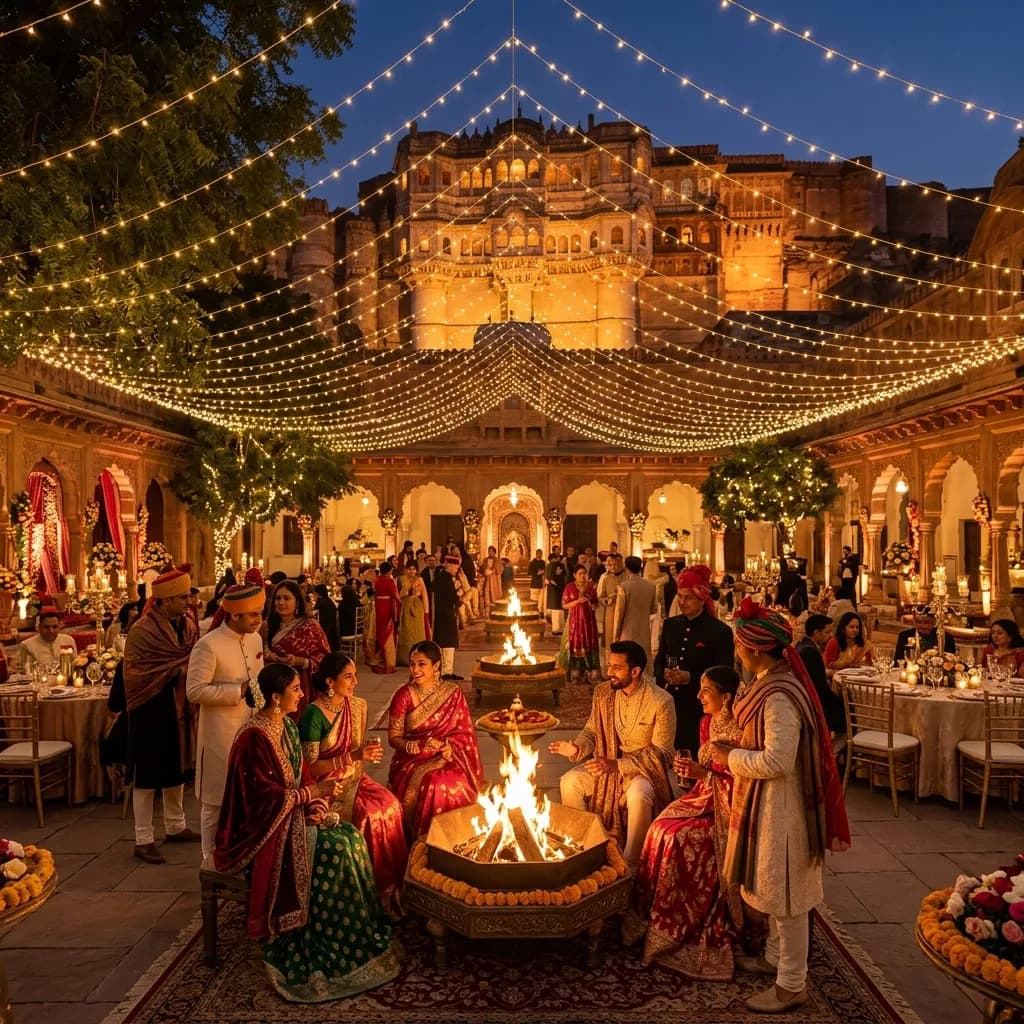
Ask any wedding planner in Jaipur for the single best time to get married in Rajasthan, and they will tell you without hesitation: November through February.
And they are right. Winter in Jaipur is genuinely magnificent. The scorching desert sun transforms into mild, golden afternoon warmth. The sky is piercingly blue every single day. The nights are clear enough to see stars from the palace lawns. It is the absolute peak season for destination weddings in Jaipur, Udaipur, and all of Rajasthan.
But here is the reality check that catches most couples completely off-guard, especially NRI families flying from warmer climates:
The Rajasthan desert gets brutally cold at night.
I have anchored midnight Phera ceremonies at 12:30 AM in January where the temperature had dropped to 6°C (43°F). The bride was visibly shivering in a thin silk lehenga. The groom could barely hold the sacred fire in his near-frozen hands. The event management team scrambled frantically to find space heaters while I improvised crowd interaction games at the mic to buy time and keep the audience's spirits up.
This is an entirely preventable situation. A winter wedding in Rajasthan requires a fundamentally different logistical and planning approach than a summer or monsoon event. Here is my complete guide to ensuring your December or January wedding not only looks magnificent but actually feels comfortable for every single guest.
1. The Timeline Shift: Your Events Must Chase the Sun
This is the single most important logistical adjustment in winter wedding planning. In a Jaipur summer, you push all outdoor activities to evening and night to avoid the heat. In a Jaipur winter, you must think in reverse — move your daytime events forward and aggressively compress your nighttime outdoor exposure.
- Mehendi Ceremony: Schedule between 11:00 AM and 3:00 PM. A winter afternoon Mehendi function in the direct Rajasthan sun is absolutely perfect — natural lighting for photography, genuine warmth for guests in light ethnic wear, and a relaxed daytime energy that makes the hours feel easy.
- Haldi Ceremony: 10:00 AM is ideal. A Haldi event in late morning winter sunlight is one of the most photogenic situations in event photography — the warm yellow colours of the turmeric paste against the crisp blue December sky create extraordinary natural colour contrast.
- Sangeet Night: December sunset is at approximately 5:30 PM. Your Sangeet anchor should open the formal program by 7:15 PM at the absolute latest. Do not push the start time to 9:00 PM — by that point, elderly guests are already cold and exhausted before the performances have even begun.
- The Varmala: Execute the Varmala and Pheras earlier than traditional midnight scheduling — ideally 8:30-9:00 PM — to ensure the most sacred moment of your wedding does not happen when guests are shivering and mentally checked out.
2. The Wardrobe Strategy: Beauty Meets Practicality
For the Bride: Do not purchase a sheer chiffon or net lehenga for any outdoor evening event planned in December or January. The photographs will be beautiful. You will be miserable.
Opt for heavy velvet, brocade silk, or raw natural silk — not just because these fabrics look dramatically regal in winter photographs, but because they provide genuine thermal mass. Commission a heavily embroidered velvet shawl that precisely matches your bridal palette. Many brides now commission matching embroidered warm capes that double as styling elements in outdoor photographs.
For the Groom: Winter is a groom's best seasonal friend. A structured, heavy velvet Sherwani or a tailored Bandhgala suit in navy, burgundy, or deep emerald looks absolutely majestic and keeps you genuinely warm during the open-air Baraat. No overheating, no sweating through the silk — just commanding, confident royalty.
For Guests: Communicate the cold reality explicitly in your digital invitation. Do not assume guests will figure it out. Include a specific clothing advisory: "Evening events are outdoors / Please plan for temperatures of 8-12°C after 9 PM / Warm shawls are recommended for ladies in sleeveless blouses."
3. Environmental Heating: The Invisible Event Expense That Is Not Optional
If your venue features sprawling outdoor lawn spaces — such as Rambagh Palace's front lawns, Fairmont's external Mughal gardens, or the heritage courtyards of Alsisar Haveli — environmental heating is not a luxury. It is a core infrastructure requirement for any evening event planned between November and February.
Budget Allocation: Many couples completely forget to budget for heating, then are shocked by the quote two weeks before the wedding. A standard outdoor Sangeet lawn holding 300 guests typically requires:
- 12-18 large gas-powered mushroom heaters (₹1,500-₹2,500 per unit per night): ₹20,000-45,000
- 4-6 decorative brass fire pits (Angeethis): ₹8,000-15,000 for rental and fuel
- Total heating budget for a 300-guest outdoor Sangeet: ₹30,000-60,000
The Pashmina Station Trend: One of the most elegant and genuinely guest-appreciated trends in luxury Rajasthan winter weddings is the dedicated "Shawl Station" at the outdoor venue entrance. You present each arriving female guest with a beautifully folded, branded pashmina shawl as their welcome gift for the evening. These double as practical warmth and as a genuinely premium wedding favour they will keep forever.
4. Menu Winterisation: The Cold Changes Everything People Want to Eat
No guest wants to hold a cold glass of fruit-infused water and a plate of tikki chaat at 9°C. Work directly with your caterer to completely reimagine your cold-season menu.
- The Welcome Drink: For a winter Baraat arrival, replace cold juices and mocktails with hot Kesar Badam Doodh (Saffron Almond Milk served in brass Kulhads), spiced Kashmiri Kahwa tea, or fresh hot Masala Chai. The crowd's response to a warm welcome drink on a cold night is immediate and profoundly appreciative.
- Live Stations: Hot Jalebi and Rabri counters, fresh-made Kulhad Chai stalls, live Daulat ki Chaat stations, and fully operational tandoor-side counters become the most visited spots at any winter Rajasthan wedding. The visual warmth of glowing tandoor coals scattered through the outdoor venue also adds enormous visual ambience.
5. Why the Anchor's Role Doubles in Importance During Winter Events
When your guests are cold, the fundamental human response is to fold inward — sit down, cross their arms, and survive the temperature rather than experience the event. This is the single biggest silent killer of a winter Sangeet's energy.
As a professional outdoor event anchor, my job at a winter wedding becomes intensely physical and psychological:
- I open the Sangeet with an explicitly physical crowd engagement — a standing cheer competition between both sides of the family that requires everyone to be physically on their feet within the first three minutes.
- I launch rapid-fire interactive games every 20 minutes specifically designed to require physical movement — standing up, competing, gesturing — to keep blood physically circulating.
- I coordinate with the DJ to open the dance floor significantly earlier than usual, knowing that dancing is the most effective crowd-warming mechanism available.
- I actively communicate warmth and excitement through my own energy projection — if the anchor sounds energetic and engaged, the audience biologically mirrors that energy level, regardless of temperature.
A great crowd-warmer is not a heater. It is a professional anchor who knows exactly when to pivot from the formal program to physical participation.
Frequently Asked Questions (FAQ)
Q: What is the coldest month for an outdoor wedding in Jaipur? A: January is typically the coldest month, with nighttime temperatures dropping to 5-8°C at the coldest points in the season. December is slightly more moderate (8-12°C at night). For couples concerned about cold, late November or early March weddings offer winter aesthetics with somewhat milder evening temperatures.
Q: Should we move the Pheras indoors for a January Jaipur wedding? A: This is a decision worth discussing carefully with your event planner in Jaipur. Moving Pheras to a fully enclosed heritage ballroom eliminates the cold issue entirely while still maintaining the aesthetic grandeur. Many top venues like Fairmont have magnificent indoor mandap spaces specifically designed for winter ceremonies.
Q: Do palace venues in Jaipur provide heaters, or do we arrange them separately? A: This varies significantly by venue. Most luxury hotels (Fairmont, Rambagh, Leela) include basic heater provisioning in their packages or have in-house suppliers. Heritage properties (Alsisar Haveli, Diggi Palace) typically require you to source and arrange heating independently through your event management team.
Q: Can we keep a Jaipur outdoor winter sangeet running until 2:00 AM? A: With adequate heating infrastructure, a well-designed pashmina station, and a high-energy anchor who knows how to keep the crowd physically active, yes — absolutely. Many of the most memorable Jaipur Sangeet nights I have anchored have run outdoors past 1:30 AM in December.
A winter wedding in Rajasthan delivers the most cinematically powerful royal aesthetics available anywhere in the world. Heavy velvet, fire pits, hot chai, and stone forts glowing in the cold night sky create unforgettable imagery.
Just assume it will be colder than you expect. Shift your timeline toward the sun. Budget for heaters. And hire an anchor who knows how to keep 400 people generating their own collective warmth.
📞 Winter Wedding Anchor Bookings: +91 7737877978 🌐 Website: www.yashsoni.in